
11 — Is the architecture healthy? Audit first, tune second
A sweep over a broken architecture optimizes the breakage. It will still return a “best” configuration, and that number will still be wrong.
This notebook takes the features from notebook 10, puts a two-branch encoder on top, and asks the model what is wrong with it before spending a single trial. There are four things wrong with it. All four are caught by watching one short training run.
import warnings
import numpy as npimport torchimport torch.nn as nnfrom IPython.display import SVGimport plotly.io as pio
import somafrom soma import ChannelConfig, Graph
pio.renderers.default = "plotly_mimetype+png"pio.renderers["png"].scale = 2pio.renderers["png"].width = 950warnings.filterwarnings("ignore", message="Full backward hook is firing")
import campaign
# Notebook 10's cached preprocessing graph produces exactly these# features; here we call the functions directly to keep this notebook# about the model.X, y = campaign.make_windows(512, seed=0)F = campaign.features(X)F = campaign.standardize(F[:384], F)xtr = torch.tensor(F[:384], dtype=torch.float32)ytr = torch.tensor(y[:384])xva = torch.tensor(F[384:], dtype=torch.float32)yva = y[384:]xtr.shape, xva.shape
(torch.Size([384, 32]), torch.Size([128, 32]))11.1 — The model, and the four things wrong with it
Section titled “11.1 — The model, and the four things wrong with it”campaign.DualViewEncoder has a branch per view, an observable fusion
point (mix), a deep trunk, and a context branch. Each pathology is a
constructor switch, so reverting one is a single, attributable change —
which is what notebook 12 needs.
| Pathology | How it gets in | What should catch it |
|---|---|---|
| Cross-branch leakage | the shape branch was copy-pasted from the spectral one and never rewired: same weights and the same input slice | LEAKAGE — CKA between the declared channel groups at mix |
| Dead channels | four post-fusion biases at −6, below the ReLU hinge, so those units emit exactly 0 forever | DEAD_CHANNELS(n) |
| Gradient-starved branch | ctx enters the sum multiplied by zero: alive in the forward pass, no gradient ever reaches it | IGNORED_CHANNELS(32) + VANISHING |
| Vanishing trunk | five tanh layers with weights scaled by 0.30 | the staircase in plot_module_flow |
The first one is the interesting bug: it is one character (:16 twice),
it does not crash, and because the two views are complementary (notebook
10) it quietly costs about thirty points of accuracy.
def build(**cfg):    torch.manual_seed(0)    g = Graph()    g.node("encoder", campaign.DualViewEncoder(**cfg))    g.node("head", campaign.Head())    g.connect("encoder", "head")    return g
SICK = dict(leak_wiring=True, dead_bias=True, starve_context=True,            trunk_gain=0.30, depth=5)
g = build(**SICK)g.materialize(xtr) # the audit silently skips filters whose module is # still None, so materialize before you auditg.train()g.make_optimizer(torch.optim.Adam, lr=1e-2)g.filter("encoder")11.2 — Watching one training run
Section titled “11.2 — Watching one training run”inside= picks which submodules to instrument, under hierarchical ids
like encoder/trunk.3. ChannelConfig.groups declares which channels
of mix came from which branch — that declaration is the contract the
leakage detector checks.
Six steps is enough. It is also deliberate: the two leaked branches receive different gradients and slowly drift apart, so their similarity is highest early. Their CKA is 1.00 at step 2 and 0.90 by step 6, while a correctly wired pair sits near 0.11 — an enormous margin either way, but not one to erode by training for longer than the diagnosis needs.
channels = ChannelConfig(    snapshot_every=2,    # The default threshold (0.95) only catches near-perfect duplication.    # Two branches at 0.90 are already redundant, and by step 6 that is    # where the leaked pair sits.    corr_threshold=0.85,    groups={"encoder/mix": {"spectral": range(0, 16), "shape": range(16, 32)}},)inside = {"encoder": ["branches.spectral", "branches.shape", "mix",                      "post", "ctx", "trunk.*"]}
with g.track_run("audit-as-found", tags=["pulse-lab"],                 hypothesis="the dual-view encoder earns its second branch") as run:    with g.gradient_audit(inside=inside, channels=channels) as audit:        for step in range(6):            with g.context() as ctx:                g.zero_grad()                out, _ = g.forward(xtr)                loss = nn.functional.cross_entropy(out, ytr)                g.backward(ctx, loss)            g.step(ctx)            run.log("train_loss", loss.detach().item(), step=step)
for f in audit.report().filters:    if f.flags:        print(f"{f.filter_id:28s} {f.flags}")
encoder/mix ['LEAKAGE']encoder/post ['DEAD_CHANNELS(6)']encoder/ctx ['VANISHING', 'IGNORED_CHANNELS(32)']Three flags, three different failures, and none of them
raised an exception. Note DEAD_CHANNELS(6) rather than 4: the four
that were planted, plus two that died on their own. Dying ReLU spreads.
The fourth pathology — the contracting trunk — is not a flag. Nothing is wrong at any single layer; the problem is the product across all five, and you see it by looking at the profile.
view = soma.RunView(run.dir)view.plot_health()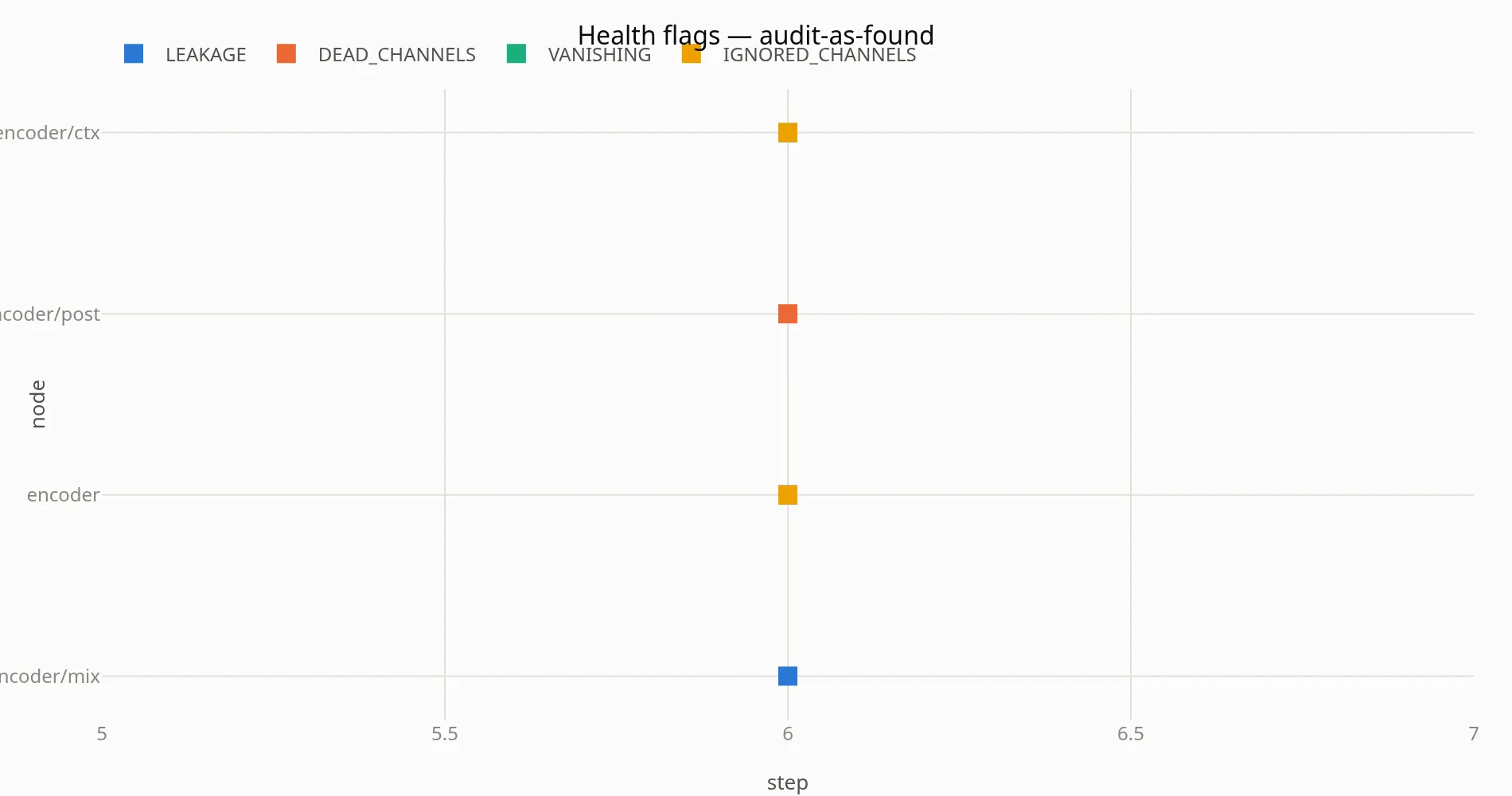
view.plot_module_flow("encoder")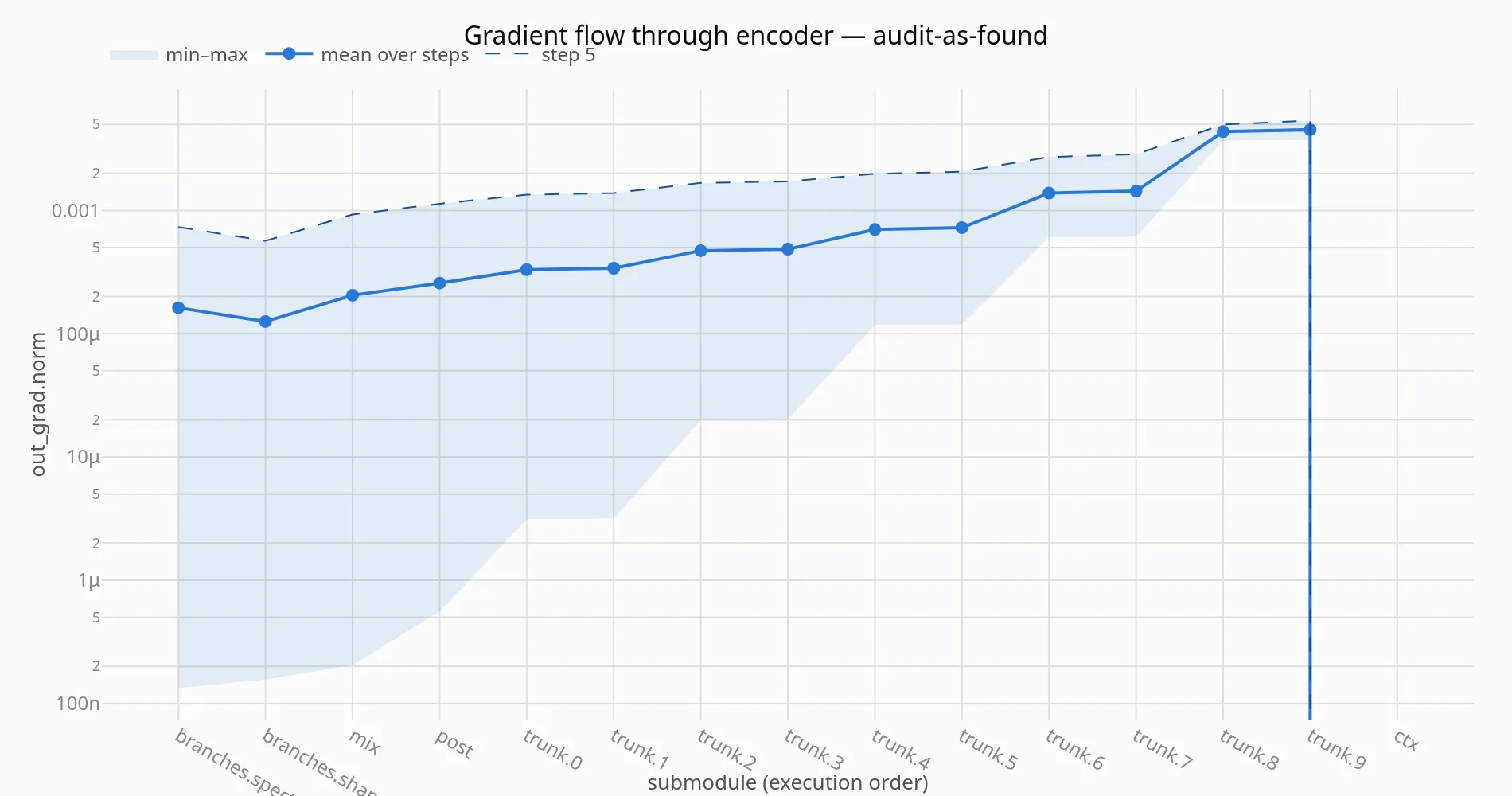
That is the staircase: gradient norm shrinking layer by layer toward the input. Whatever the first layers might have learned, nothing reaches them to learn it with.
SVG(view.to_svg(node="encoder"))view.plot_channels("encoder/mix")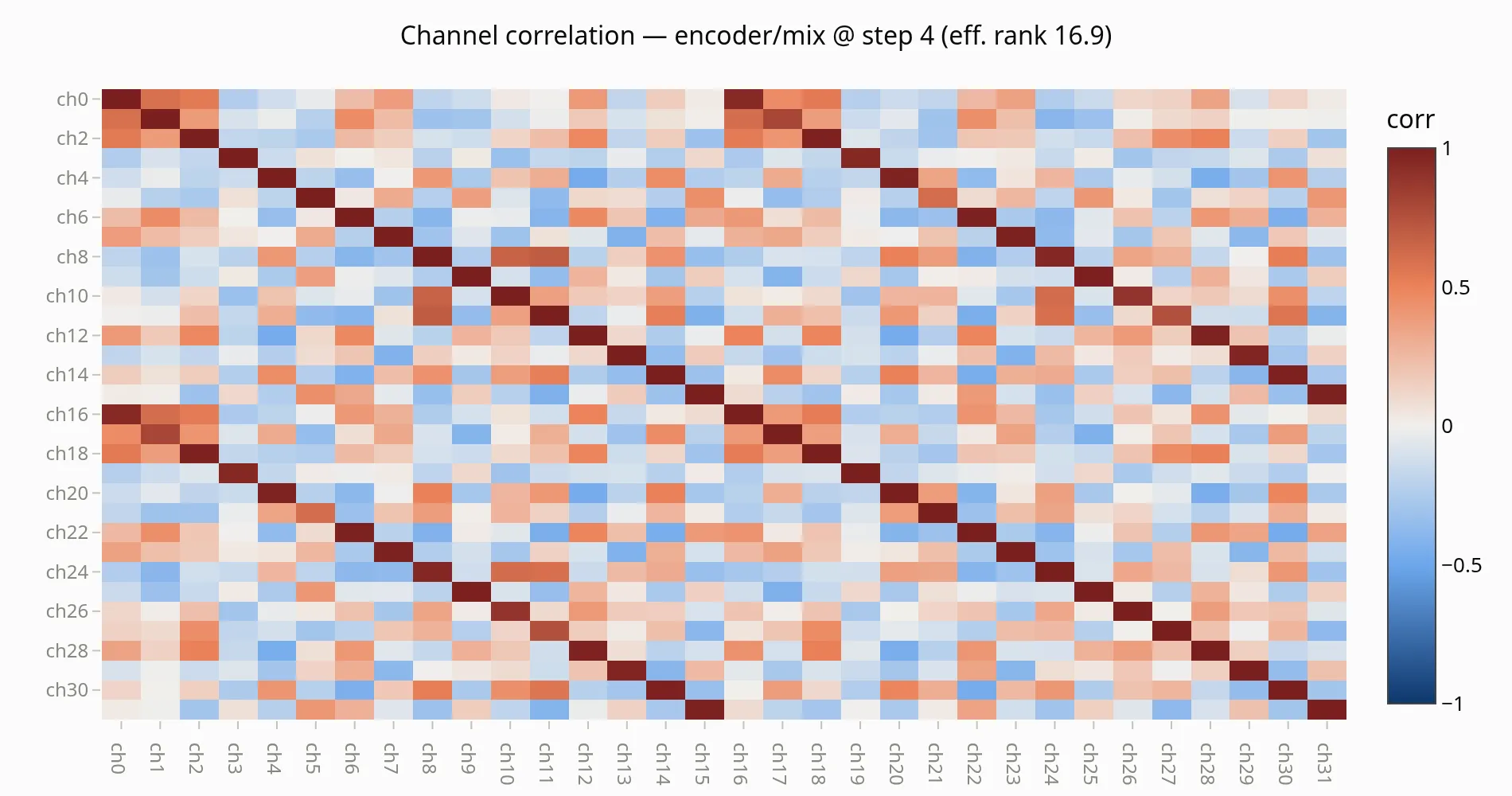
Channels 0–15 (spectral) and 16–31 (shape) have the same profile, because they are computing the same thing from the same input. Half the fusion layer’s input is a duplicate.
view.plot_channel_evolution("encoder/mix")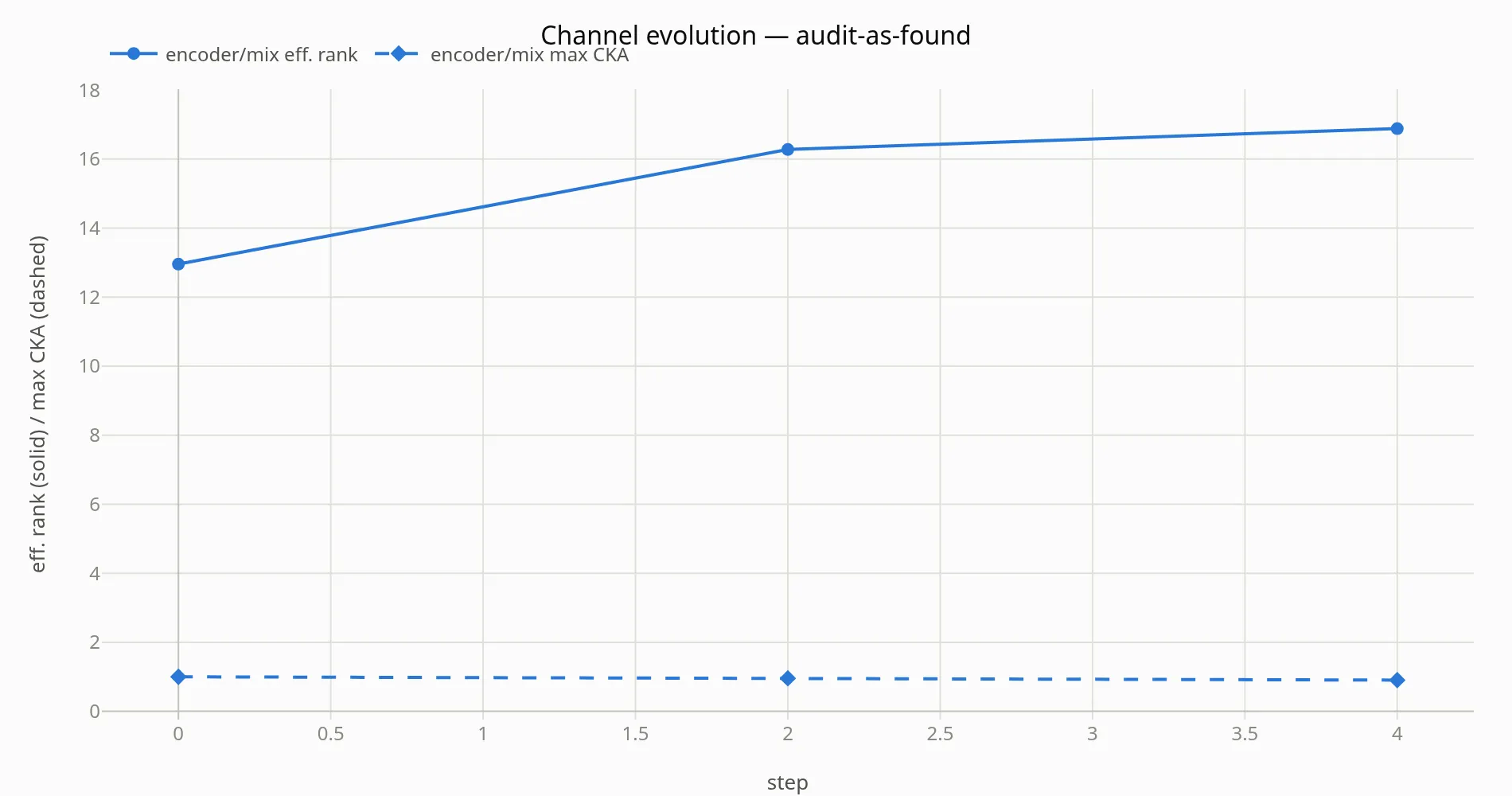
# The flags roll up to the outer graph, so the DAG shows# you which node to look inside without parsing any ids.for flag in view.health_flags(): if flag["node_id"] == "encoder": print(f"{flag['flag']:22s} {flag['detail']}")SVG(view.to_svg())DEAD_CHANNELS in: postIGNORED_CHANNELS in: ctxLEAKAGE in: mixVANISHING in: ctx11.3 — Fix all four
Section titled “11.3 — Fix all four”Each fix is one switch. Whether each one matters is notebook 12’s question — here we just want an architecture worth tuning.
g_fixed = build(depth=5)   # every switch back to its healthy defaultg_fixed.materialize(xtr)g_fixed.train()g_fixed.make_optimizer(torch.optim.Adam, lr=1e-2)
with g_fixed.track_run("audit-fixed", tags=["pulse-lab"]) as run_fixed:    with g_fixed.gradient_audit(inside=inside, channels=channels) as audit_fixed:        for step in range(6):            with g_fixed.context() as ctx:                g_fixed.zero_grad()                out, _ = g_fixed.forward(xtr)                g_fixed.backward(ctx, nn.functional.cross_entropy(out, ytr))            g_fixed.step(ctx)
before = {f.filter_id: f.flags for f in audit.report().filters if f.flags}after = {f.filter_id: f.flags for f in audit_fixed.report().filters if f.flags}for node in sorted(set(before) | set(after)):    print(f"{node:28s} {str(before.get(node, [])):46s} -> {after.get(node, [])}")
encoder/ctx ['VANISHING', 'IGNORED_CHANNELS(32)'] -> []encoder/mix ['LEAKAGE'] -> []encoder/post ['DEAD_CHANNELS(6)'] -> ['DEAD_CHANNELS(1)']LEAKAGE, IGNORED_CHANNELS and VANISHING are gone. One dead channel remains, out of 32, which is ordinary ReLU attrition rather than a planted fault — worth knowing about, not worth chasing.
soma.RunView(run_fixed.dir).plot_module_flow("encoder")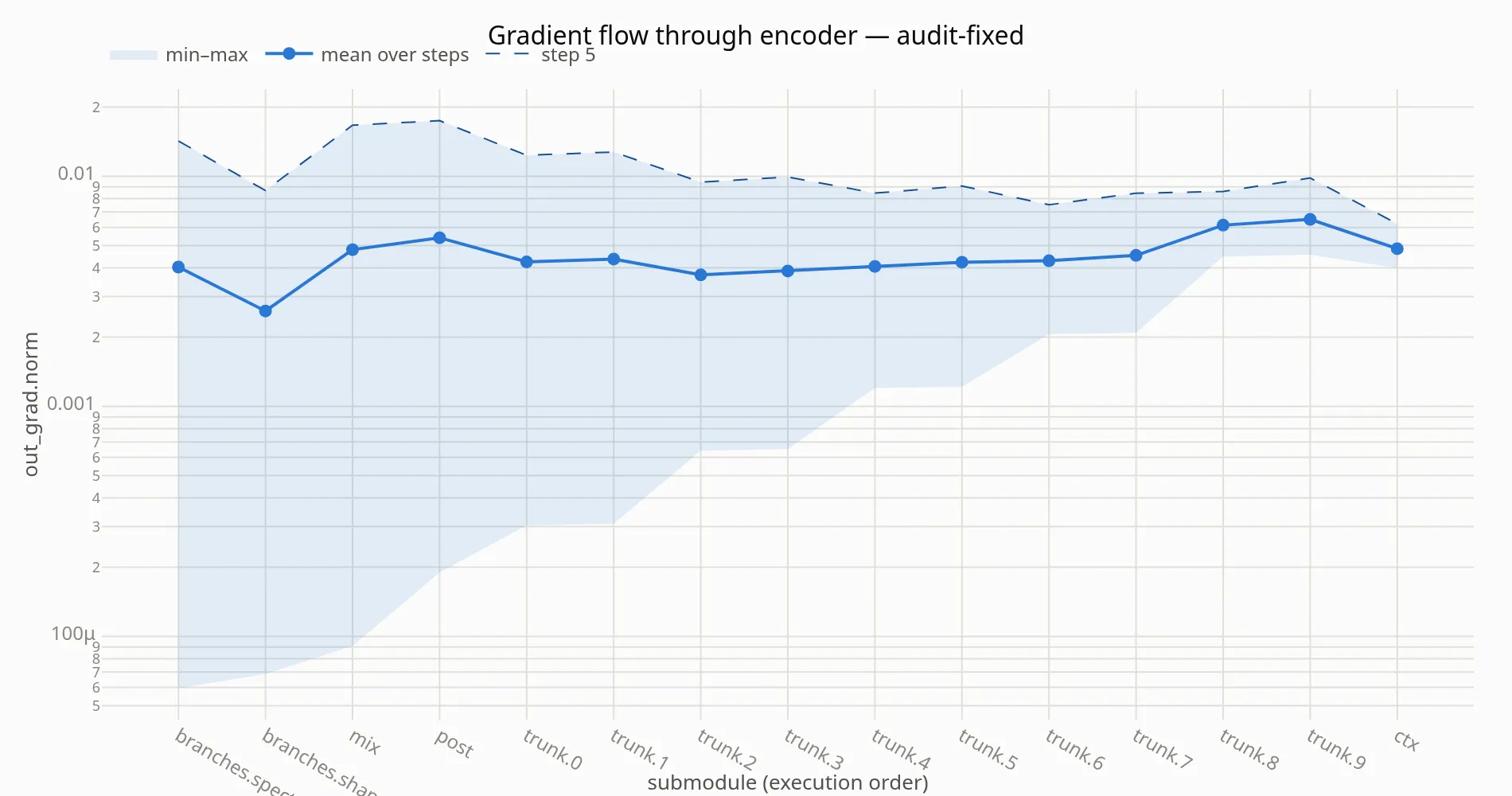
Same axes as before. The profile is flat: gradient reaches every layer.
11.4 — Now a sweep is worth running
Section titled “11.4 — Now a sweep is worth running”One thing to know before reading the next cell: with strategy="grid",
n_trials is the number of points per dimension, not the total. Two
dimensions at 3 points is 9 trials. A third dimension would make it 27.
search_space = [    {"type": "float", "name": "lr", "low": 3e-3, "high": 3e-2, "scale": "log"},    {"type": "int", "name": "head_hidden", "low": 8, "high": 24},]
def objective(trial):    torch.manual_seed(0)    t = Graph()    t.node("encoder", campaign.DualViewEncoder(depth=5))    t.node("head", campaign.Head(hidden=trial["head_hidden"]))    t.connect("encoder", "head")    t.materialize(xtr)    t.train()    t.make_optimizer(torch.optim.Adam, lr=trial["lr"])
    for epoch in range(8):        order = torch.randperm(384)        for i in range(0, 384, 64):            idx = order[i:i + 64]            with t.context() as ctx:                t.zero_grad()                out, _ = t.forward(xtr[idx])                t.backward(ctx, nn.functional.cross_entropy(out, ytr[idx]))            t.step(ctx)        t.eval()        with torch.no_grad():            acc = campaign.accuracy(np.asarray(t.forward(xva)), yva)        t.train()        if trial.report("val_acc", acc, epoch):   # True => pruned            return None    return {"val_acc": acc}
study = soma.Study(    "pulse-grid",    search_space=search_space,    strategy="grid",    n_trials=3,                      # per dimension: 3 x 3 = 9 trials    objectives=[("val_acc", "maximize")],    pruning=("median", 3),    tags=["pulse-lab"],)study.run(objective)   # progress=True draws a tqdm bar in a live sessionprint("best:", study.best_trial["params"], "->", study.best_trial["metrics"])
best: {'head_hidden': 16, 'lr': 0.00948683298050514} -> {'val_acc': 0.984375}soma.viz.trials_dataframe(study).dataframe tbody tr th { vertical-align: top;}
.dataframe thead th { text-align: right;}| trial_id | state | started_at | finished_at | duration_ms | param_head_hidden | param_lr | metric_val_acc | |
|---|---|---|---|---|---|---|---|---|
| 0 | trial_0000 | completed | 2026-08-04 00:35:22.460765711+00:00 | 2026-08-04 00:35:22.755539679+00:00 | 294 | 8 | 0.003000 | 0.976562 |
| 1 | trial_0001 | completed | 2026-08-04 00:35:22.755948716+00:00 | 2026-08-04 00:35:22.883858869+00:00 | 127 | 16 | 0.003000 | 0.984375 |
| 2 | trial_0002 | pruned | 2026-08-04 00:35:22.884367084+00:00 | 2026-08-04 00:35:23.035128051+00:00 | 150 | 24 | 0.003000 | 0.968750 |
| 3 | trial_0003 | pruned | 2026-08-04 00:35:23.035657944+00:00 | 2026-08-04 00:35:23.191253973+00:00 | 155 | 8 | 0.009487 | 0.968750 |
| 4 | trial_0004 | completed | 2026-08-04 00:35:23.191891109+00:00 | 2026-08-04 00:35:23.349372683+00:00 | 157 | 16 | 0.009487 | 0.984375 |
| 5 | trial_0005 | pruned | 2026-08-04 00:35:23.350409381+00:00 | 2026-08-04 00:35:23.455549429+00:00 | 105 | 24 | 0.009487 | 0.960938 |
| 6 | trial_0006 | pruned | 2026-08-04 00:35:23.456552615+00:00 | 2026-08-04 00:35:23.533558184+00:00 | 76 | 8 | 0.030000 | 0.585938 |
| 7 | trial_0007 | pruned | 2026-08-04 00:35:23.534465951+00:00 | 2026-08-04 00:35:23.604238409+00:00 | 69 | 16 | 0.030000 | 0.648438 |
| 8 | trial_0008 | pruned | 2026-08-04 00:35:23.605153521+00:00 | 2026-08-04 00:35:23.688560814+00:00 | 83 | 24 | 0.030000 | 0.796875 |
study.plot_optimization_history()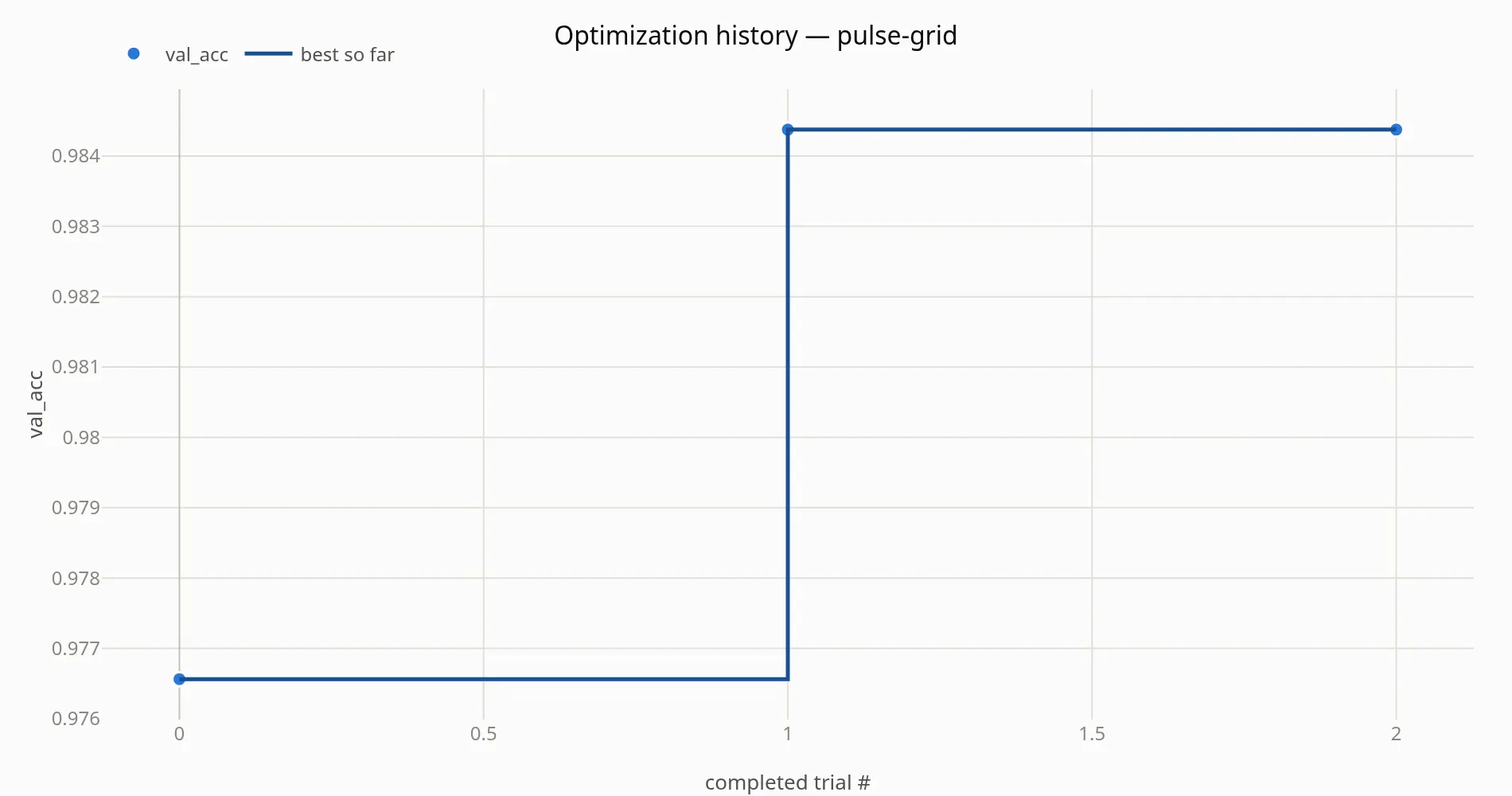
study.plot_parallel_coordinate()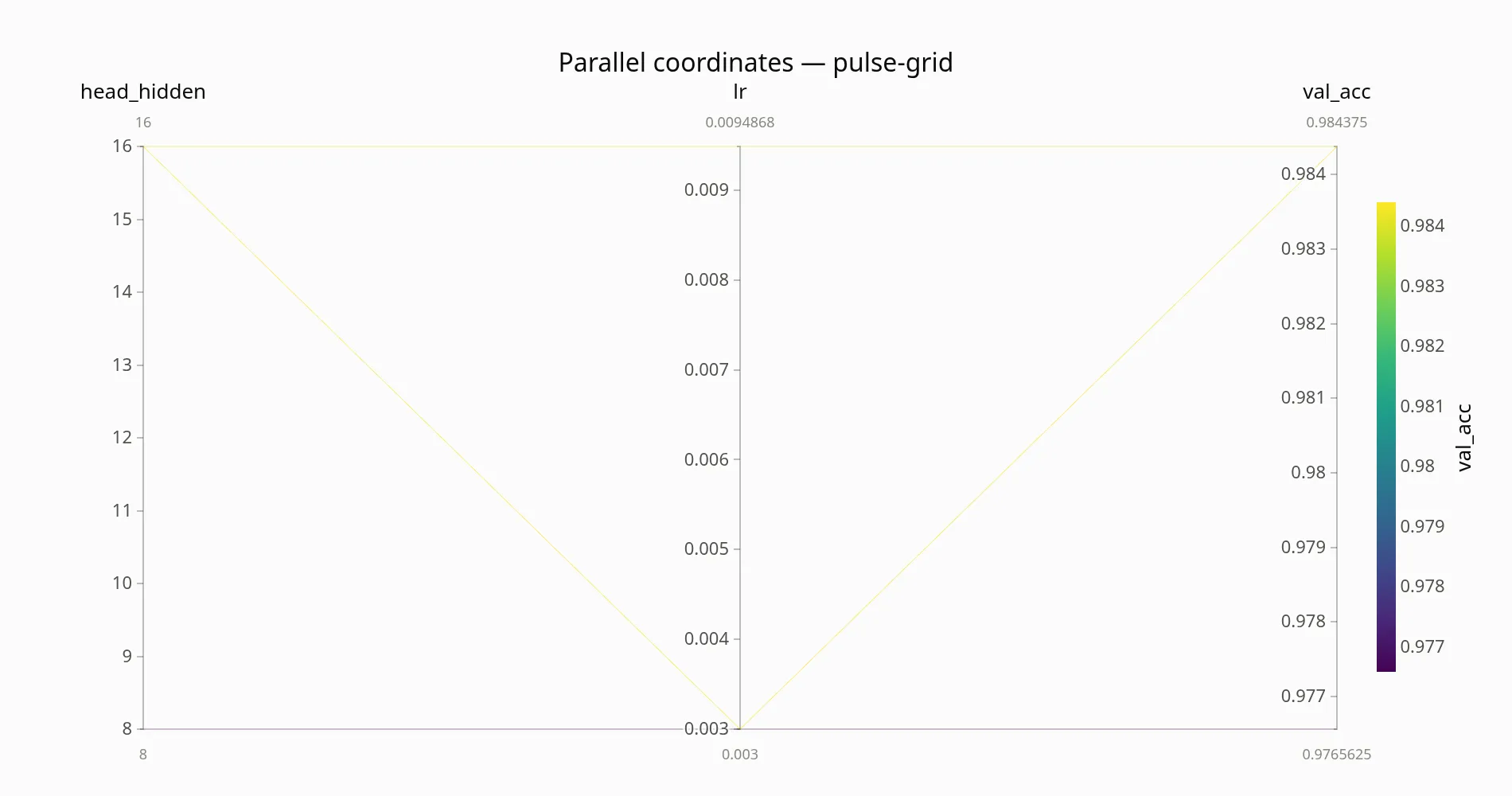
What’s next
Section titled “What’s next”Fixing four things at once told us the model can be fixed. It did not tell us which fix mattered — and notebook 12 shows that the answer is not the one you would guess from this notebook.