

08 — Auditing inside a node
At graph level, gradient_audit() treats every filter as opaque: one record
per node per step. With inside=, the hooks go into the node’s model and each
submodule is audited under a hierarchical id (encoder/<module.path>) — the
same records, flags, persistence and figures. Here it catches a textbook
vanishing gradient.
import warnings
import plotly.io as pioimport torchimport torch.nn as nn
import soma
# Silencing PyTorch's benign warning about backward hooks.# Interactivo (zoom/hover/brushing) en Jupyter y VS Code, con# fallback PNG donde no hay JS (GitHub incluido).pio.renderers.default = "plotly_mimetype+png"pio.renderers["png"].scale = 2      # crisp on retina displayspio.renderers["png"].width = 950warnings.filterwarnings("ignore", message="Full backward hook is firing")from soma import AuditScope, DifferentiableFilter, Graph

class DeepEncoder(DifferentiableFilter):    _cache_version = "nb08-deep-v1"
    def __init__(self, layers=12):        super().__init__(layers=layers)
    def build_module(self, input_shape):        mods = []        for _ in range(self.layers):            lin = nn.Linear(input_shape[-1], input_shape[-1])            with torch.no_grad():                lin.weight.mul_(0.35)  # init contractiva: gradientes se apagan            mods += [lin, nn.Tanh()]        return nn.Sequential(*mods)
    def output_shape(self, input_shape):        return input_shape

torch.manual_seed(0)g = Graph()enc = DeepEncoder()g.node("encoder", enc)x, y = torch.randn(64, 8), torch.randn(64, 8)g.materialize(x)g.train()g.make_optimizer(torch.optim.Adam, lr=1e-3)
Adam (Parameter Group 0 amsgrad: False betas: (0.9, 0.999) capturable: False decoupled_weight_decay: False differentiable: False eps: 1e-08 foreach: None fused: None lr: 0.001 maximize: False weight_decay: 0)A materialized DifferentiableFilter draws itself too: its submodules
with parameters, chained in order, with the θ count per layer.
encinside=True: no configuration at all
Section titled “inside=True: no configuration at all”It selects direct children that have parameters, descending through wrappers that hold a single child. The root node keeps being audited under its plain id. The alternatives are all the same thing underneath:
g.gradient_audit(inside={"encoder": 2})            # int = depthg.gradient_audit(inside={"encoder": ["0", "4.*"]}) # fnmatch patternsg.gradient_audit(inside={"encoder": AuditScope(depth=3, sample_every=10)})
class DeepEncoder(DifferentiableFilter):    _audit_scope = "auto"   # declared where the model lives
Precedence: inside[...] > the class’s _audit_scope > auto.
with g.track_run("nb08-inside", tags=["demo"]) as run:    with g.gradient_audit(inside=True) as audit:        for epoch in range(4):            with g.context() as ctx:                g.zero_grad()                out, _ = g.forward(x)                g.backward(ctx, nn.functional.mse_loss(out, y))            g.step(ctx)
print(audit.report().pretty())
filter steps act|μ| act σ |out∂| |θ∂| |θ| ∂/θ flags---------------------------------------------------------------------------------------------------------------------------------- encoder 4 2.176e-01 2.119e-01 9.568e-02 2.778e-01 2.845e+00 9.765e-02 HEALTHY encoder/0 4 2.166e-01 2.624e-01 1.931e-09 1.120e-08 7.447e-01 1.503e-08 VANISHING encoder/2 4 1.993e-01 2.315e-01 1.322e-08 4.892e-08 8.452e-01 5.787e-08 VANISHING encoder/4 4 1.770e-01 2.026e-01 8.374e-08 3.280e-07 8.164e-01 4.017e-07 HEALTHY encoder/6 4 1.876e-01 2.247e-01 4.840e-07 1.822e-06 8.897e-01 2.048e-06 HEALTHY encoder/8 4 1.320e-01 1.559e-01 2.361e-06 9.146e-06 7.380e-01 1.239e-05 HEALTHY encoder/10 4 2.281e-01 2.488e-01 9.397e-06 3.364e-05 9.080e-01 3.705e-05 HEALTHY encoder/12 4 2.448e-01 2.572e-01 4.302e-05 1.699e-04 8.493e-01 2.000e-04 HEALTHY encoder/14 4 1.457e-01 1.886e-01 1.886e-04 7.710e-04 7.457e-01 1.034e-03 HEALTHY encoder/16 4 1.837e-01 1.893e-01 6.889e-04 2.417e-03 7.794e-01 3.101e-03 HEALTHY encoder/18 4 1.805e-01 2.096e-01 3.261e-03 1.047e-02 8.097e-01 1.293e-02 HEALTHY encoder/20 4 2.220e-01 2.130e-01 1.783e-02 5.768e-02 7.814e-01 7.382e-02 HEALTHY encoder/22 4 2.233e-01 2.180e-01 9.049e-02 2.715e-01 9.202e-01 2.951e-01 HEALTHYGradient flow, layer by layer
Section titled “Gradient flow, layer by layer”The classic plot: submodules in real execution order on x, |∂| on a log
scale on y. A vanishing gradient reads as a staircase falling towards the
input — here, several orders of magnitude of it.
view = soma.RunView(run.dir)view.plot_module_flow("encoder")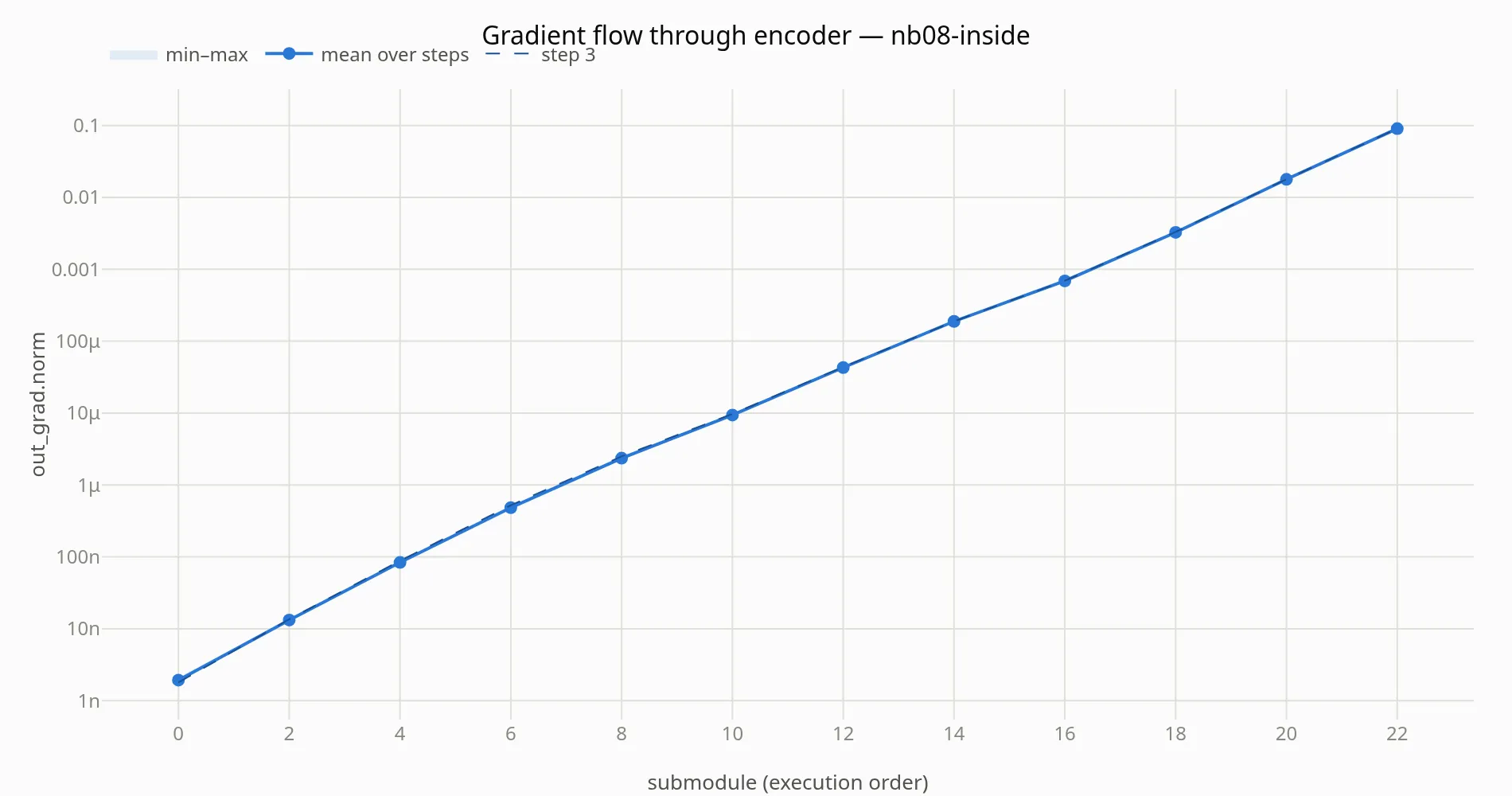
The inner architecture, annotated
Section titled “The inner architecture, annotated”The submodule tree is persisted to diagnostics/modules/encoder.json — the
same Graph schema as graph.json — and rendered through the same overlay
mechanism: parameters, mean |∂| and flags, per layer.
from IPython.display import SVG
SVG(view.to_svg(node="encoder")) # flags and |∂| per layer; to_mermaid(node=...) da la fuente mermaidFlags, rolled up
Section titled “Flags, rolled up”Every flagged layer emits its own HealthFlag and the parent node
receives one aggregated per family, whose detail names the layers. The outer
DAG marks the node; the inner views point at the exact layer.
parent = [f for f in view.health_flags() if f["node_id"] == "encoder"]children = [f for f in view.health_flags() if f["node_id"].startswith("encoder/")]print(f"{len(children)} flags de capa; rollup en el padre:")[f["detail"] for f in parent]2 flags de capa; rollup en el padre:['in: 0, 2']# Series temporales por capa (por defecto plot_audit solo muestra# roots; node="encoder" would bring them all and warn about the limit of 8).# Comparamos entrada / medio / salida:view.plot_audit( filters=["encoder", "encoder/0", "encoder/10", "encoder/18"], metric="out_grad.norm",)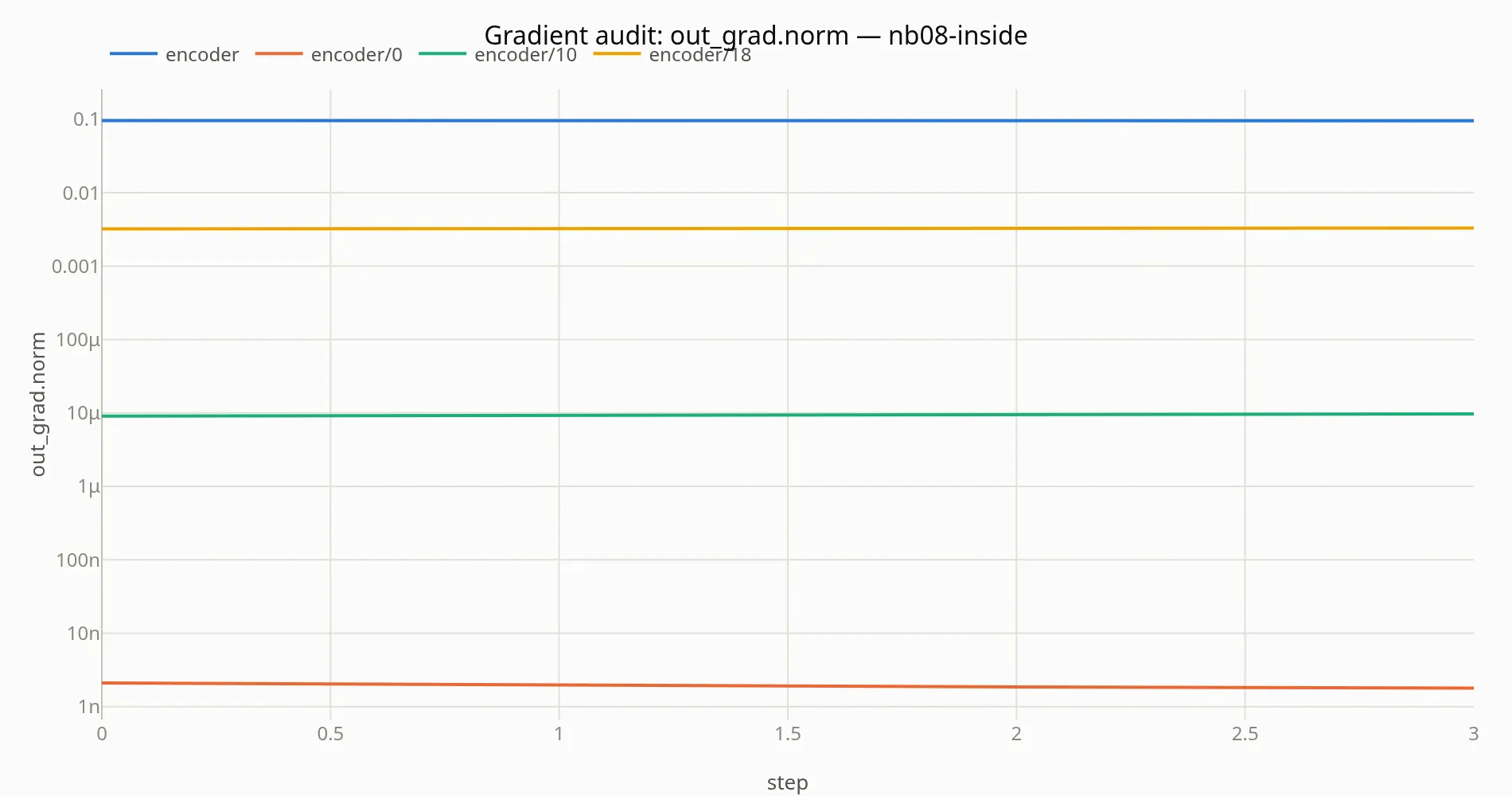
soma report <run_id> carries all of this in the report’s Module flow
section. For large models, AuditScope(sample_every=N) samples the submodules
every N steps (the root always records), and max_modules caps the selection
with a warning — never silently.