

09 — Complex architectures, and their health
Two realistic scenarios. First a multimodal pipeline (a fork and a
fan-in), to see how a non-trivial topology reads. Then a complex model
inside a single node, into which we inject four training pathologies
documented in the literature — and catch all four with
gradient_audit(inside=..., channels=...) at the default thresholds.
import warnings
import plotly.io as pioimport torchimport torch.nn as nnfrom IPython.display import SVG
import somafrom soma import ChannelConfig, DifferentiableFilter, Filter, Graph
# Interactivo (zoom/hover/brushing) en Jupyter y VS Code, con# fallback PNG donde no hay JS (GitHub incluido).pio.renderers.default = "plotly_mimetype+png"pio.renderers["png"].scale = 2pio.renderers["png"].width = 950warnings.filterwarnings("ignore", message="Full backward hook is firing")
9.1 — A multimodal pipeline
Section titled “9.1 — A multimodal pipeline”Two preprocessing branches, audio and text, converging on a fusion, a shared
backbone and two heads. Evaluating g draws the topology.
class LoadAudio(Filter):    _cache_version = "nb09-la-v1"    def forward(self, x, state):        return [v * 1.0 for v in x]
class Mfcc(Filter):    _cache_version = "nb09-mfcc-v1"    def fit(self, x, y=None):        return {"scale": max(abs(v) for v in x) or 1.0}    def forward(self, x, state):        return [v / state["scale"] for v in x]
class LoadText(Filter):    _cache_version = "nb09-lt-v1"    def forward(self, x, state):        return [v + 0.5 for v in x]
class Embed(Filter):    _cache_version = "nb09-emb-v1"    def forward(self, x, state):        return [v * 0.1 for v in x]
class Fuse(Filter):    _cache_version = "nb09-fuse-v1"    def forward(self, x, state):        # Fan-in: x = {node_id: rama}        return [sum(vals) for vals in zip(*x.values())]
class Backbone(Filter):    _cache_version = "nb09-bb-v1"    def fit(self, x, y=None):        return {"mean": sum(x) / len(x)}    def forward(self, x, state):        return [v - state["mean"] for v in x]
class ClfHead(Filter):    _cache_version = "nb09-clf-v1"    def forward(self, x, state):        return [1.0 if v > 0 else 0.0 for v in x]
class RegHead(Filter):    _cache_version = "nb09-reg-v1"    def forward(self, x, state):        return [v * 2.0 for v in x]
g = Graph.somatize( (LoadAudio() >> Mfcc() | LoadText() >> Embed()) >> Fuse() >> Backbone() >> (ClfHead() | RegHead()))gAfter running it under track_run, the same diagram is annotated with what
happened: per-node duration, cache hits, statuses.
with g.track_run("nb09-pipeline", kind="fit", tags=["demo"]) as run:    g.fit([3.0, -1.0, 2.0, 5.0, -4.0])
pipe_view = soma.RunView(run.dir)SVG(pipe_view.to_svg())pipe_view.plot_gantt()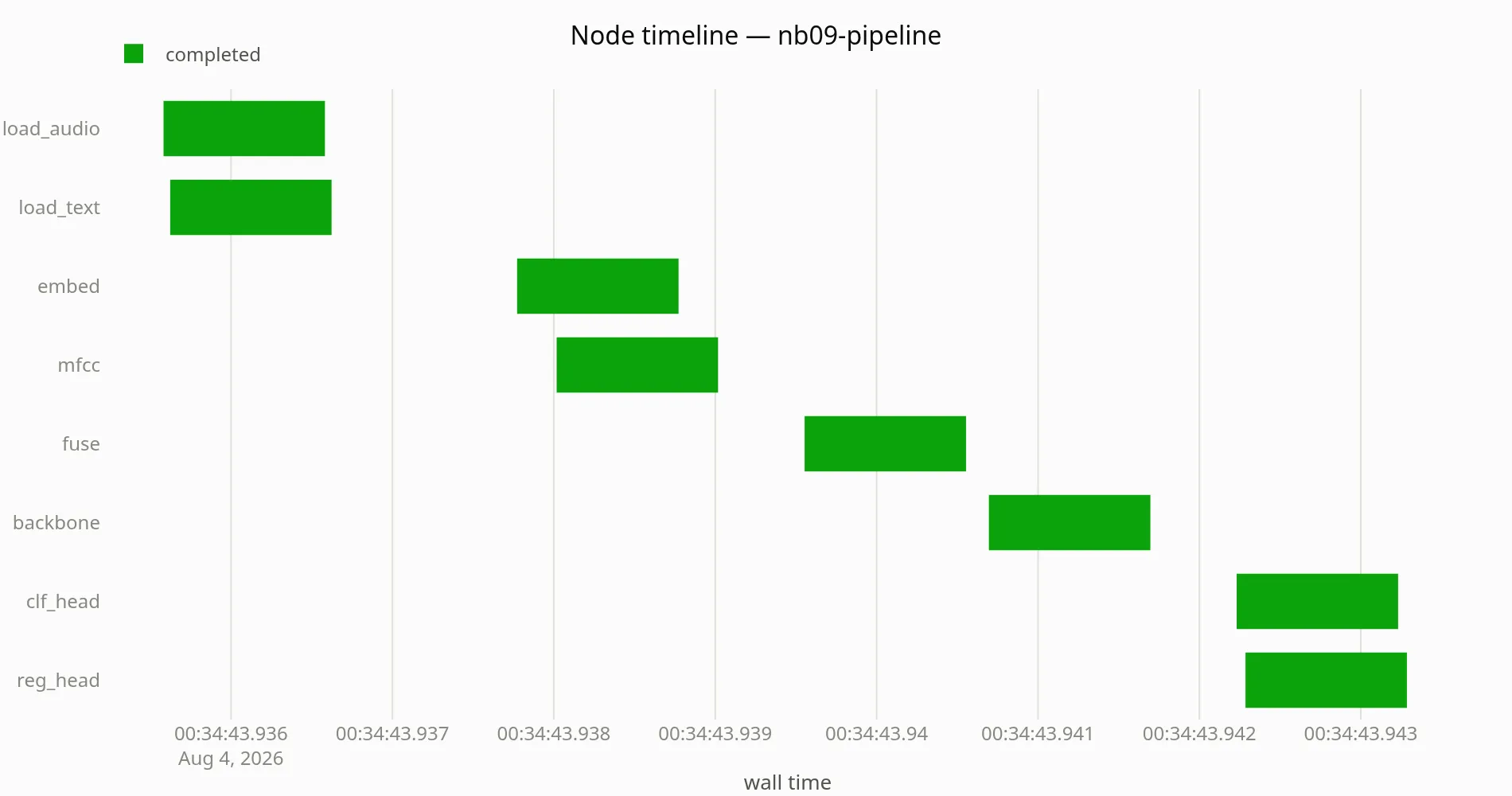
9.2 — A complex model inside a node, with pathologies
Section titled “9.2 — A complex model inside a node, with pathologies”MultiModalEncoder has per-modality branches, an observable fusion point
(mix), a deep trunk and a context branch. We inject four classic faults:
| Pathology | How we inject it | Detector that must fire |
|---|---|---|
| Dead channels (dying ReLU) | four biases of the post-fusion layer set to −6, before the ReLU | DEAD_CHANNELS(≥4) |
| Leakage between modalities | both branches collapsed onto the same weights, so they encode the same thing | LEAKAGE (CKA between groups > 0.95) |
| A branch the gradient ignores | ctx enters the forward multiplied by 0 — alive in the forward pass, no gradient | IGNORED_CHANNELS(32) + VANISHING |
| A vanishing trunk | five tanh layers with weights ×0.30 | the staircase in plot_module_flow |
class MultiModalEncoder(DifferentiableFilter):    _cache_version = "nb09-mm-v1"
    def build_module(self, input_shape):        branches = nn.ModuleDict({            "audio": nn.Sequential(nn.Linear(16, 16), nn.ReLU()),            "text": nn.Sequential(nn.Linear(16, 16), nn.ReLU()),        })        with torch.no_grad():            # leakage: branches collapsed onto the same weights            branches["text"][0].weight.copy_(branches["audio"][0].weight)            branches["text"][0].bias.copy_(branches["audio"][0].bias)        post = nn.Sequential(nn.Linear(32, 32), nn.ReLU())        with torch.no_grad():            post[0].bias[-4:] = -6.0   # dying ReLU after the fusion        trunk = []        for _ in range(5):            lin = nn.Linear(32, 32)            with torch.no_grad():                lin.weight.mul_(0.30)   # contractivo → vanishing            trunk += [lin, nn.Tanh()]        return nn.ModuleDict({            "branches": branches,            "mix": nn.Identity(),        # observes the fused vector [audio|text]            "post": post,            "trunk": nn.Sequential(*trunk),            "ctx": nn.Linear(32, 32),    # will be multiplied by 0 in the forward            "head": nn.Linear(32, 8),        })
    def output_shape(self, input_shape):        return (8,)
    def forward(self, x, state=None):        import numpy as np        x_t = x if isinstance(x, torch.Tensor) else torch.as_tensor(np.asarray(x), dtype=torch.float32)        self.materialize(tuple(x_t.shape[1:]))        m = self._module        a = m["branches"]["audio"](x_t[:, :16])        t = m["branches"]["text"](x_t[:, 16:])        mixed = m["mix"](torch.cat([a, t], dim=1))        deep = m["trunk"](m["post"](mixed))        out = m["head"](deep + 0.0 * m["ctx"](mixed))        if self.training:            return out, {}        return out.detach().tolist(), {}

torch.manual_seed(0)g2 = Graph()enc = MultiModalEncoder()g2.node("encoder", enc)
audio = torch.randn(96, 16)x = torch.cat([audio, audio * 0.97 + 0.05 * torch.randn(96, 16)], dim=1)y = torch.randn(96, 8)g2.materialize(x)g2.train()g2.make_optimizer(torch.optim.Adam, lr=1e-3)enc # the model draws itselfAuditing inside, with channel groups
Section titled “Auditing inside, with channel groups”inside= selects which submodules to watch (fnmatch patterns), and
ChannelConfig.groups declares which channels of mix belong to which
modality — the basis of the CKA leakage detector.
cfg = ChannelConfig(    snapshot_every=2,    groups={"encoder/mix": {"audio": range(0, 16), "text": range(16, 32)}},)
with g2.track_run("nb09-health", tags=["demo"]) as run2:    with g2.gradient_audit(        inside={"encoder": ["branches.audio", "branches.text", "mix", "post", "ctx", "trunk.*"]},        channels=cfg,    ) as audit:        for epoch in range(6):            with g2.context() as ctx:                g2.zero_grad()                out, _ = g2.forward(x)                g2.backward(ctx, nn.functional.mse_loss(out, y))            g2.step(ctx)
for f in audit.report().filters:    if f.flags:        print(f"{f.filter_id:26s} {f.flags}")
encoder/mix ['LEAKAGE']encoder/post ['DEAD_CHANNELS(5)']encoder/ctx ['VANISHING', 'IGNORED_CHANNELS(32)']All four pathologies, caught at the default thresholds. Now the same conclusions, visually:
view = soma.RunView(run2.dir)view.plot_health() # what failed, where, and at which step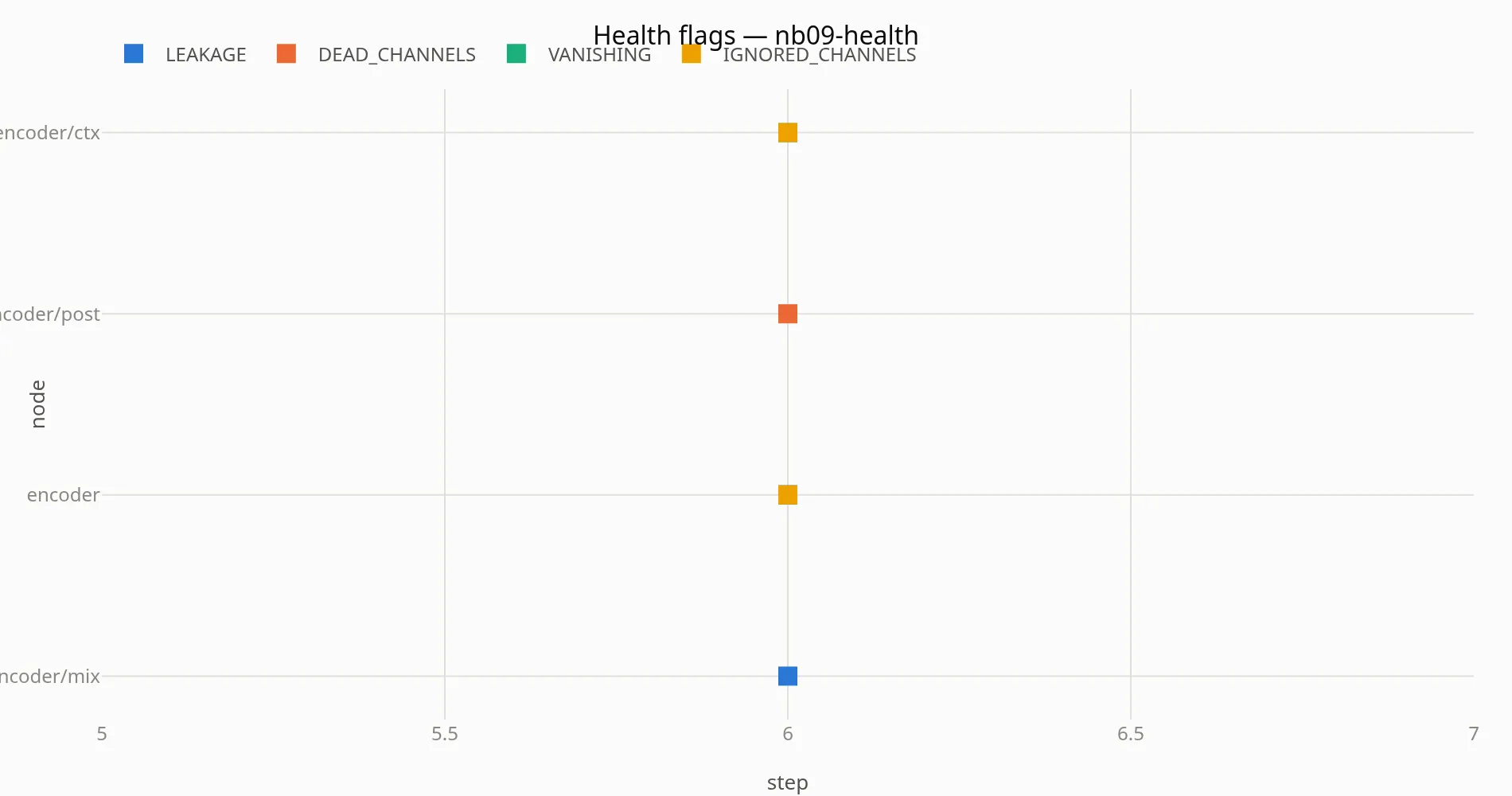
SVG(view.to_svg(node="encoder")) # the inner architecture, layer by layerview.plot_module_flow("encoder") # the trunk's vanishing staircase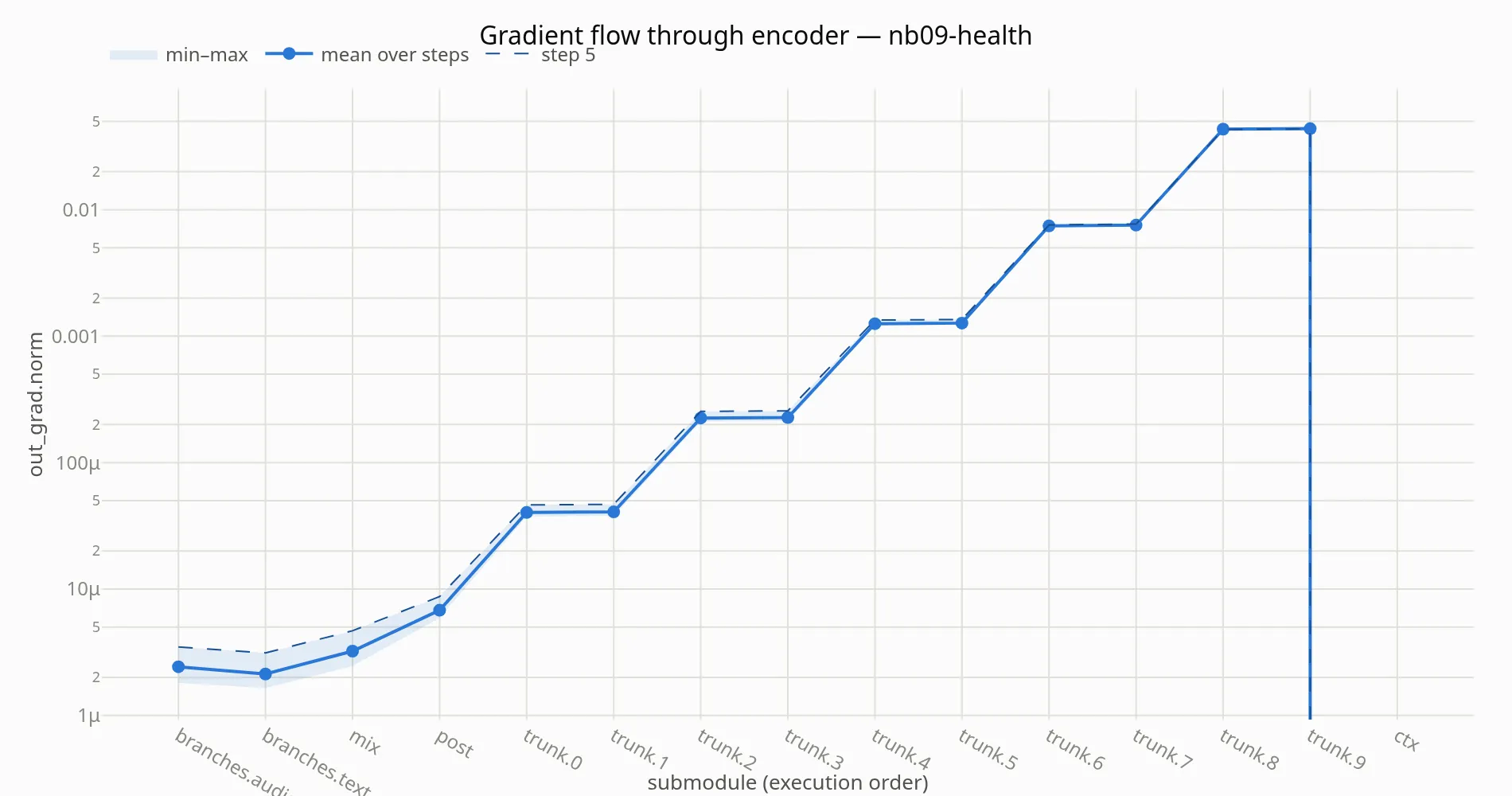
view.plot_channels("encoder/mix") # audio↔texto correlacionados + 4 canales muertos (†)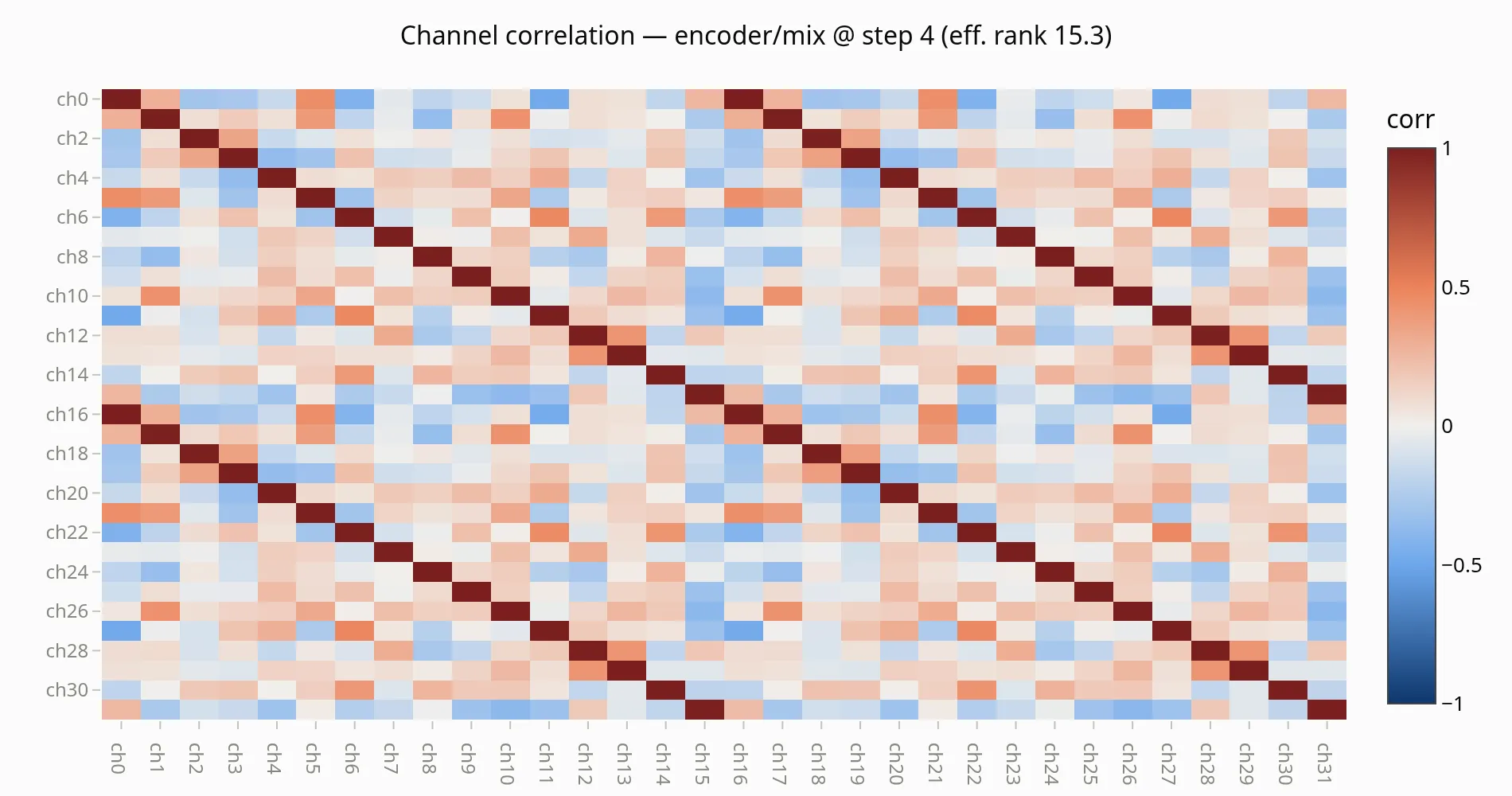
view.plot_channel_evolution("encoder/mix") # effective rank and CKA across traininging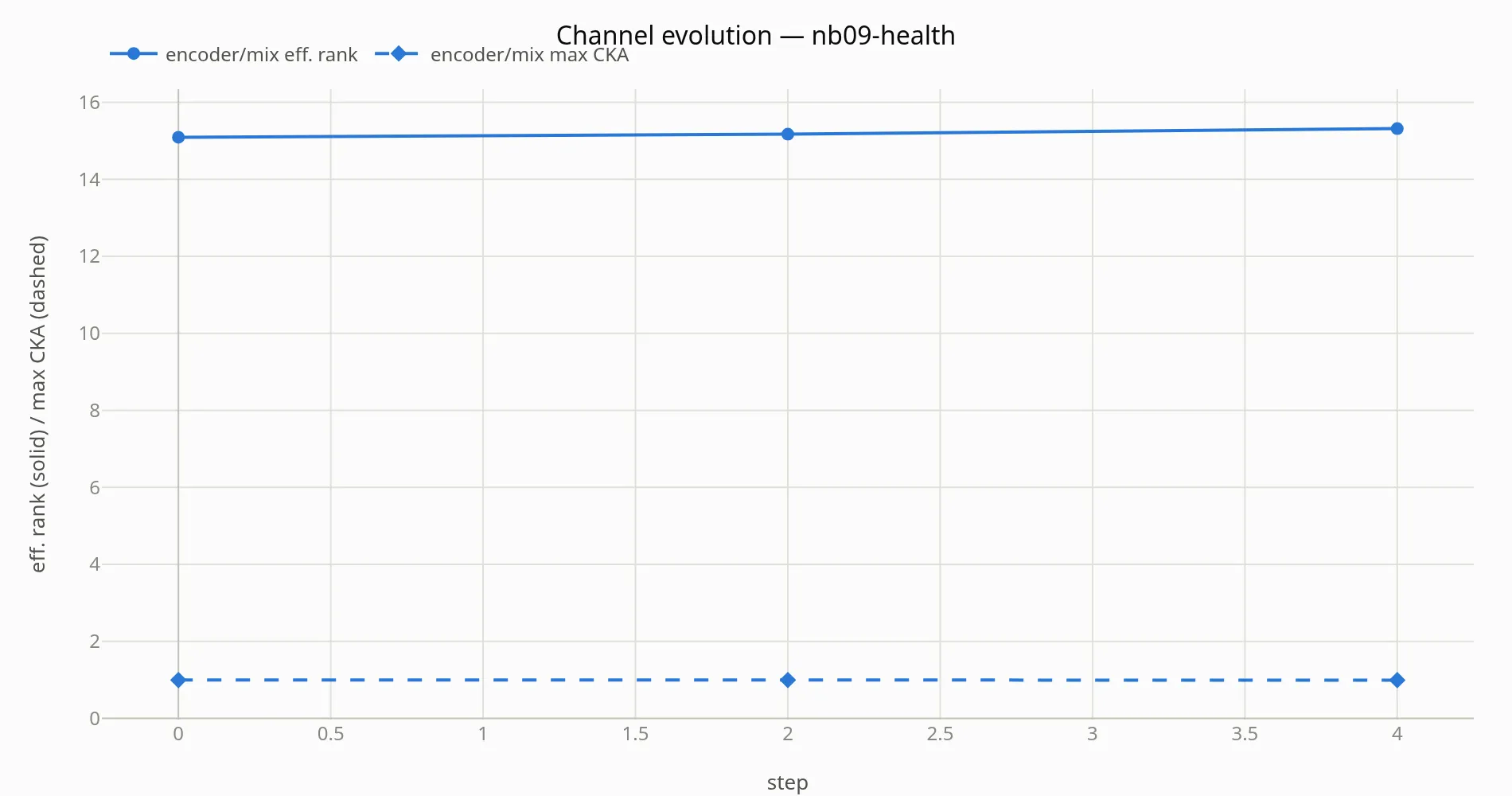
And on the outer DAG, the rollup marks the encoder node with the detail of
which submodules failed — the graph tells you where to look, the inner views
tell you what happened.
parent = [f for f in view.health_flags() if f["node_id"] == "encoder"]for f in parent: print(f"{f['flag']:18s} {f['detail']}")SVG(view.to_svg())DEAD_CHANNELS in: postIGNORED_CHANNELS in: ctxLEAKAGE in: mixVANISHING in: ctxsoma report <run_id> packages every one of these views — the Module flow
section included — into a shareable HTML file. The full guide is
docs → guides/gradient-audit.md, section Looking inside a node.